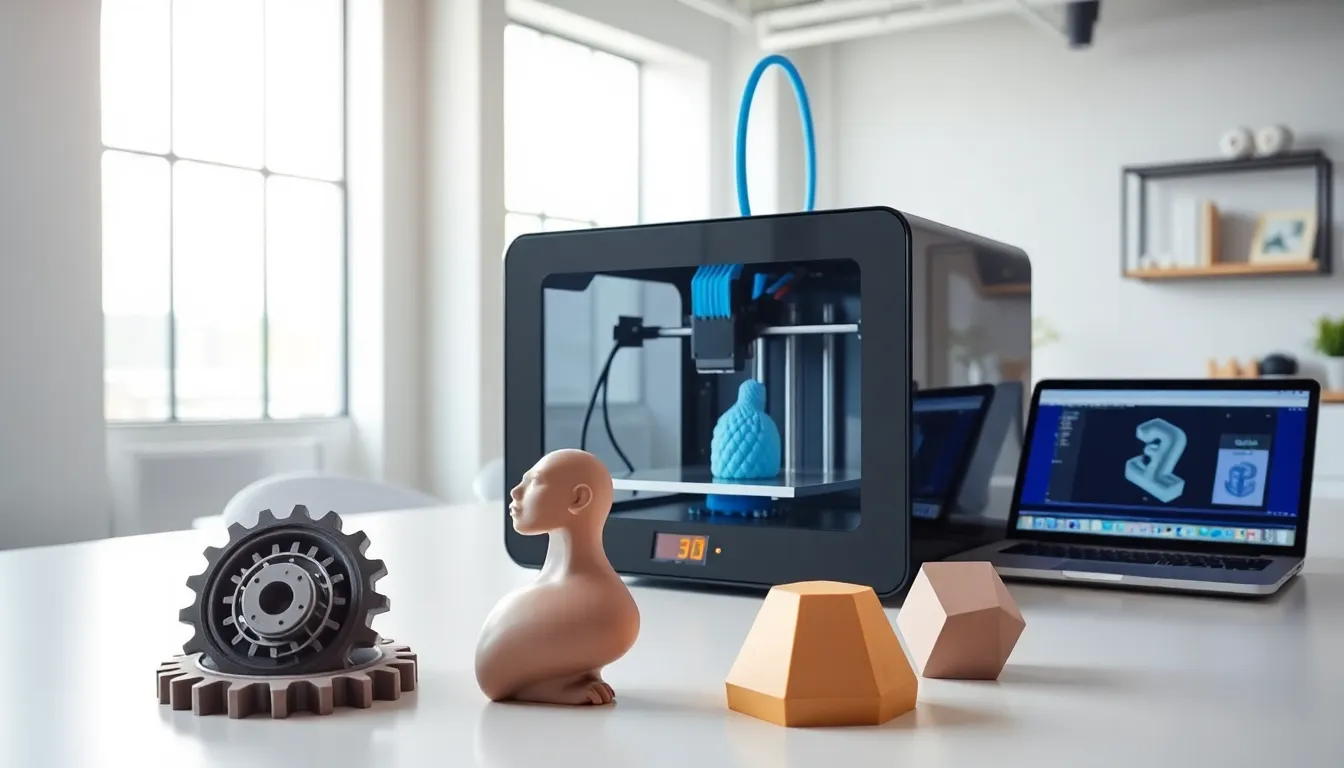
Top 3D printing has become a mainstream technology in 2025. Hobbyists print custom parts at home. Manufacturers produce aerospace components on factory floors. The industry continues to grow at a rapid pace.
This guide covers the most popular 3D printing technologies available today. It explores the best printers for home and professional use. Readers will discover emerging applications across multiple industries. The article also provides practical advice for choosing the right 3D printer.
Table of Contents
ToggleKey Takeaways
- Top 3D printing technologies in 2025 include FDM, SLA, SLS, and MJF—each suited for different applications from hobbyist projects to industrial production.
- Home users can achieve excellent print quality with printers like the Bambu Lab P1S and Elegoo Saturn 4, both priced under $1,000.
- Industries such as healthcare, aerospace, and construction are rapidly adopting 3D printing for custom implants, lightweight aircraft parts, and affordable housing.
- Choose your 3D printer based on primary use case, material requirements, build volume, and budget to ensure it meets your specific needs.
- Strong online communities and manufacturer support make top 3D printing accessible to beginners and help users troubleshoot issues quickly.
Most Popular 3D Printing Technologies
Several 3D printing technologies dominate the market in 2025. Each method offers distinct advantages for specific applications.
Fused Deposition Modeling (FDM)
FDM remains the most widely used 3D printing technology. A heated nozzle extrudes thermoplastic filament layer by layer. This method offers low costs and easy operation. Most desktop 3D printers use FDM technology. Materials include PLA, ABS, PETG, and specialty filaments like carbon fiber composites.
Stereolithography (SLA)
SLA uses ultraviolet light to cure liquid resin into solid objects. This technology produces highly detailed prints with smooth surfaces. Dental labs and jewelry makers prefer SLA for its precision. The process creates parts with layer heights as fine as 25 microns.
Selective Laser Sintering (SLS)
SLS fuses powdered materials using a high-powered laser. This technology works with nylon, polyamide, and metal powders. Industrial manufacturers choose SLS for functional prototypes and end-use parts. The process requires no support structures because the powder bed supports each layer.
Multi Jet Fusion (MJF)
HP developed Multi Jet Fusion technology for industrial production. The process applies fusing agents to powder layers and heats them with infrared energy. MJF produces strong, consistent parts at higher speeds than SLS. Many companies use this top 3D printing method for batch production.
Best 3D Printers for Home and Professional Use
The market offers 3D printers at every price point. Home users and professionals can find machines that match their needs and budgets.
Top 3D Printing Options for Home Use
The Bambu Lab P1S delivers excellent print quality under $1,000. It features automatic bed leveling, enclosed printing, and multi-color capabilities. The Creality K1 offers similar performance at a lower price point. Both printers handle PLA, PETG, and TPU filaments without difficulty.
For resin printing at home, the Elegoo Saturn 4 provides a large build volume with 12K resolution. Hobbyists use it for miniatures, figurines, and detailed models. The Anycubic Photon Mono M7 offers comparable quality with faster print speeds.
Professional-Grade 3D Printers
The Formlabs Form 4 leads the professional SLA market. It prints dental models, prototypes, and production parts with outstanding accuracy. The machine costs around $4,500 but delivers industrial-quality results.
For large-scale production, the HP Jet Fusion 5200 handles high-volume manufacturing. Companies produce thousands of identical parts per week. This top 3D printing system costs over $300,000 but reduces per-part costs significantly.
The Markforged FX20 prints continuous carbon fiber reinforced parts. Aerospace and automotive companies use it for tooling and structural components. The resulting parts rival aluminum in strength-to-weight ratio.
Emerging Applications and Industries
3D printing continues to expand into new industries and applications. Several sectors show remarkable growth in 2025.
Healthcare and Medical Devices
Hospitals now print patient-specific surgical guides and implants. Surgeons use 3D printed models to plan complex procedures. Dental labs produce crowns, bridges, and aligners directly from digital scans. The medical 3D printing market exceeds $5 billion globally.
Bioprinting research advances rapidly. Scientists print tissue scaffolds and organ models for drug testing. Full organ printing remains years away, but progress accelerates each quarter.
Aerospace and Defense
Aircraft manufacturers print lightweight components that reduce fuel consumption. GE Aviation produces fuel nozzles and turbine blades using metal 3D printing. SpaceX prints rocket engine parts that would be impossible to manufacture traditionally. Top 3D printing technologies enable designs with internal channels and complex geometries.
Construction and Architecture
Large-scale 3D printers now build houses in under 48 hours. Companies like ICON and Alquist print affordable housing foundations and walls. The technology uses concrete-based materials that cost less than traditional construction methods.
Consumer Products and Fashion
Adidas mass-produces 3D printed midsoles for running shoes. Eyewear companies print custom-fit frames from face scans. Jewelry designers create intricate pieces impossible to craft by hand. These applications demonstrate how top 3D printing impacts everyday products.
How to Choose the Right 3D Printer
Selecting a 3D printer requires careful consideration of several factors. The right choice depends on intended use, budget, and technical requirements.
Define the Primary Use Case
Hobbyists printing toys and household items need different machines than engineers prototyping mechanical parts. Art and design work often requires fine detail and smooth surfaces. Functional parts demand material strength and dimensional accuracy. Start by listing the types of objects to print.
Consider Material Requirements
FDM printers work with the widest range of materials. Users can print PLA for basic projects or carbon fiber composites for strength. SLA printers produce smoother surfaces but limit material choices to various resins. Industrial users should consider SLS or MJF for nylon and metal printing.
Evaluate Build Volume Needs
Build volume determines the maximum object size. Small desktop printers offer build areas around 220mm x 220mm x 250mm. Large-format machines print objects over a meter in any dimension. Larger printers cost more and require more space. Most home users find mid-sized build volumes sufficient.
Set a Realistic Budget
Entry-level FDM printers start under $200. Quality desktop machines cost $500 to $2,000. Professional SLA printers range from $3,000 to $10,000. Industrial systems exceed $100,000. Factor in ongoing costs for materials, maintenance, and post-processing equipment.
Research Community Support
Popular 3D printers have active online communities. Users share settings, troubleshooting tips, and modifications. Brands like Prusa and Bambu Lab maintain extensive documentation and responsive customer service. Strong community support makes top 3D printing accessible to beginners.