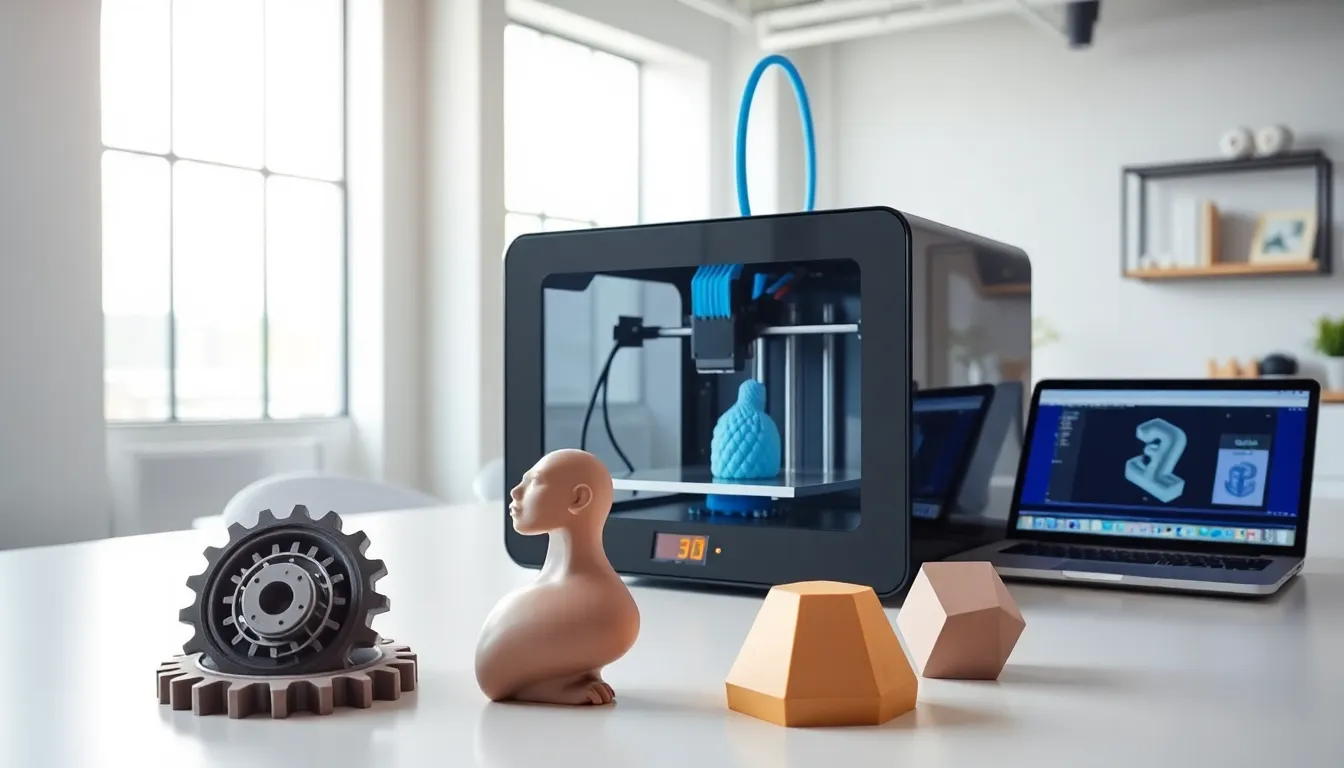
The 3D printing trends 2026 landscape is shaping up to be transformative. Additive manufacturing has moved well beyond prototyping into full-scale production, medical breakthroughs, and everyday consumer applications. Industry experts predict the global 3D printing market will exceed $50 billion by 2026, driven by faster machines, smarter software, and greener materials. This article breaks down the six most significant 3D printing trends 2026 will bring, from AI-powered design tools to bioprinted organs and sustainable filaments. Whether someone works in manufacturing, healthcare, or simply owns a desktop printer, these developments will reshape how products get made.
Table of Contents
ToggleKey Takeaways
- The global 3D printing market will exceed $50 billion by 2026, fueled by faster machines, smarter software, and sustainable materials.
- AI-driven design tools will cut product development time by 40-60% by generating optimized geometries in minutes.
- Sustainable 3D printing trends 2026 include recycled filaments, bio-based resins, and closed-loop recycling systems that eliminate waste.
- Medical 3D printing is advancing toward functional bioprinted tissues, patient-specific implants, and on-demand surgical tools in hospitals.
- Industrial 3D printing now competes with injection molding for production runs up to 10,000 units, especially for complex or customized parts.
- Consumer desktop printers under $500 now achieve professional-quality results with print speeds exceeding 500mm/s.
AI-Driven Design and Automation
Artificial intelligence is changing how engineers and designers approach 3D printing. In 2026, AI-driven design tools will generate optimized geometries faster than human designers ever could. These systems analyze stress points, weight distribution, and material properties to create parts that perform better while using less material.
Generative design software like Autodesk Fusion 360 and nTopology already offers AI-assisted features. By 2026, these tools will become standard across industries. Users input constraints, maximum weight, required strength, budget, and the AI produces dozens of viable designs in minutes. This approach cuts development time by 40-60% according to recent industry reports.
Automation extends beyond design. Smart print farms now use machine learning to monitor builds in real time. Cameras detect failed prints early, sensors adjust temperatures automatically, and algorithms schedule jobs for maximum efficiency. Companies like Carbon and HP have integrated these capabilities into their industrial systems.
The 3D printing trends 2026 will bring also include automated post-processing. Support removal, surface finishing, and quality inspection, traditionally manual tasks, are becoming fully automated. This reduces labor costs and improves consistency across large production runs.
Sustainable Materials and Eco-Friendly Printing
Sustainability has become a priority for the 3D printing industry. By 2026, eco-friendly materials will dominate both consumer and industrial markets. Manufacturers are responding to demand for greener options with recycled filaments, bio-based resins, and energy-efficient machines.
Recycled plastics are gaining traction. Companies now produce high-quality PLA and PETG filaments from post-consumer waste. These materials perform comparably to virgin plastics at similar price points. Some manufacturers have achieved 100% recycled content without sacrificing print quality.
Bio-based materials represent another major 3D printing trend 2026 will accelerate. Algae-derived polymers, hemp-based composites, and mycelium (mushroom) materials are entering commercial production. These alternatives break down naturally and reduce dependence on petroleum-based plastics.
Energy consumption is also improving. Newer 3D printers use up to 50% less power than models from five years ago. LED-based resin curing, better thermal insulation, and smarter heating systems all contribute to lower carbon footprints.
Closed-loop recycling systems are becoming common in industrial settings. Failed prints and support structures get ground up and re-extruded on-site. This approach eliminates waste and reduces material costs. Several companies now offer integrated recycling modules that attach directly to their printers.
Medical and Bioprinting Advancements
Medical 3D printing is advancing rapidly. The 3D printing trends 2026 will showcase include functional organ tissues, patient-specific implants, and on-demand surgical tools. Hospitals and research labs are integrating additive manufacturing into everyday care.
Bioprinting has moved from experimental to practical. Researchers can now print skin grafts, cartilage, and bone scaffolds that integrate with human tissue. Clinical trials for bioprinted corneas and liver tissue patches are underway. Full organ printing remains years away, but incremental progress continues.
Custom implants are already standard practice. Surgeons order patient-specific hip joints, cranial plates, and spinal cages printed from titanium or PEEK plastic. These devices match individual anatomy precisely, improving outcomes and reducing surgery time. Major medical device companies like Stryker and Zimmer Biomet have dedicated 3D printing divisions.
Point-of-care printing is expanding. Hospitals are installing their own 3D printers to produce surgical guides, anatomical models, and custom tools on-site. This reduces wait times from weeks to hours. The FDA has streamlined approval pathways for 3D printed medical devices, encouraging adoption.
Dental applications continue to grow. Clear aligners, crowns, bridges, and dentures are increasingly 3D printed. The speed and precision of modern dental printers have made traditional manufacturing methods obsolete for many applications.
Industrial-Scale Production and Manufacturing
3D printing is becoming a genuine manufacturing technology. In 2026, more factories will use additive manufacturing for end-use parts, not just prototypes. Speed improvements, larger build volumes, and lower per-part costs are driving this shift.
Metal 3D printing leads industrial adoption. Binder jetting and laser powder bed fusion machines now produce thousands of parts per day. Automotive companies print brake components, aerospace firms manufacture turbine blades, and tooling shops create injection molds. These parts meet or exceed the quality of traditionally manufactured alternatives.
The 3D printing trends 2026 manufacturers are watching include multi-material printing. New systems deposit different materials in a single build, combining rigid and flexible sections, or embedding electronics directly into parts. This capability opens possibilities that conventional manufacturing cannot match.
Supply chain resilience drives adoption. Companies learned during recent global disruptions that local production capability matters. 3D printing enables on-demand manufacturing closer to end customers. Spare parts, custom components, and small-batch products can be produced without overseas shipping delays.
Cost curves continue to decline. As machine utilization increases and material prices drop, 3D printing becomes competitive with injection molding for runs up to 10,000 units. For complex geometries or customized products, additive manufacturing already wins on price.
Consumer Accessibility and Desktop Innovation
Desktop 3D printers have never been better or cheaper. The 3D printing trends 2026 consumers will experience include faster print speeds, easier setup, and professional-quality results from sub-$500 machines.
Print speed has improved dramatically. Core XY and delta motion systems, combined with high-flow hotends, achieve speeds exceeding 500mm/s. A print that took eight hours in 2023 now finishes in under two. Bambu Lab, Creality, and Prusa have pushed consumer expectations higher with each new release.
Ease of use has improved equally. Modern printers feature automatic bed leveling, filament sensors, and cloud-based slicing. First-time users can unbox a printer and start their first successful print within an hour. Wireless connectivity and mobile apps make remote monitoring simple.
Material options have expanded. Consumer printers now handle carbon fiber composites, flexible TPU, wood-filled PLA, and even metal-filled filaments. What once required industrial machines is now possible on a desktop.
Community resources make learning easier. Free model repositories like Printables and Thingiverse offer millions of designs. YouTube tutorials cover every technique from basic calibration to advanced multi-color printing. The barrier to entry has never been lower.