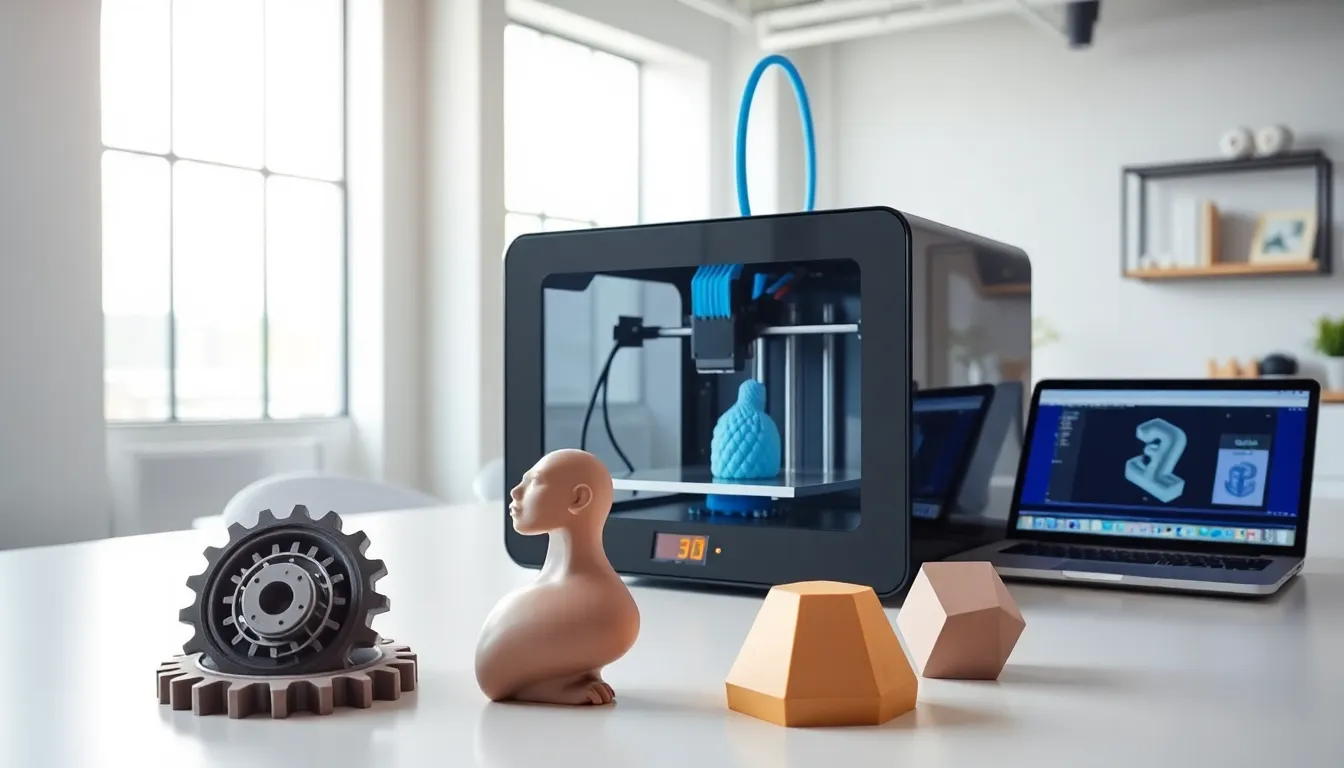
3D printing examples now span nearly every major industry, from life-saving medical devices to custom aerospace components. This technology has moved far beyond prototyping. Today, companies use additive manufacturing to produce end-use parts, reduce costs, and accelerate production timelines.
The applications are impressive, and growing. Surgeons print patient-specific implants. Engineers create lightweight aircraft parts. Architects build scale models in hours instead of weeks. Even everyday consumers can access custom products that were impossible just a decade ago.
This article explores real-world 3D printing examples across healthcare, aerospace, automotive, construction, and consumer goods. Each section highlights specific use cases that demonstrate how this technology delivers practical value right now.
Table of Contents
ToggleKey Takeaways
- 3D printing examples now span healthcare, aerospace, automotive, construction, and consumer goods—moving far beyond simple prototyping.
- Medical applications include custom prosthetics delivered in days, patient-specific implants, and surgical guides that reduce operation times by up to 25%.
- Aerospace leaders like GE Aviation and SpaceX use 3D printing to create lighter, more durable components while cutting production time from months to days.
- Construction companies are printing entire homes at roughly 30% lower cost than traditional building methods, addressing housing shortages efficiently.
- Consumer products from Adidas midsoles to custom eyewear demonstrate how 3D printing enables mass personalization at scale.
- Replacement parts for obsolete or discontinued items represent one of the most practical everyday 3D printing examples for consumers.
Healthcare and Medical Applications
Healthcare provides some of the most compelling 3D printing examples available today. Medical professionals use this technology to create custom implants, prosthetics, surgical guides, and even bioprinted tissues.
Custom Implants and Prosthetics
Traditional prosthetics often require multiple fittings and lengthy production times. 3D printing changes that equation entirely. Patients can now receive custom-fitted prosthetic limbs within days rather than weeks.
Companies like Unlimited Tomorrow produce personalized prosthetic arms using 3D scanning and printing. Each device matches the patient’s exact measurements and skin tone. The cost? Significantly lower than conventional alternatives.
Orthopedic implants represent another major application. Surgeons can print titanium hip cups, spinal cages, and cranial plates designed specifically for individual patients. These implants often feature lattice structures that encourage bone integration, something traditional manufacturing cannot easily achieve.
Surgical Planning and Guides
Surgeons increasingly rely on 3D-printed anatomical models for pre-operative planning. Before a complex procedure, a medical team can examine a physical replica of a patient’s tumor, heart defect, or bone fracture.
These models reduce surgical time and improve outcomes. A 2023 study in the Journal of Medical Devices found that 3D-printed surgical guides decreased operation times by an average of 25%.
Bioprinting and Future Possibilities
Researchers are pushing 3D printing examples into more ambitious territory. Bioprinting uses living cells as “ink” to create tissue structures. Scientists have already printed skin grafts, cartilage, and blood vessels in laboratory settings.
Full organ printing remains years away from clinical use. But the progress is real. Companies like Organovo and CELLINK continue to advance this field, bringing the possibility of printed organs closer to reality.
Aerospace and Automotive Innovations
Aerospace and automotive industries have embraced 3D printing examples with particular enthusiasm. The reasons are straightforward: weight reduction, part consolidation, and faster iteration cycles.
Aerospace Components
GE Aviation produces LEAP engine fuel nozzles using metal 3D printing. Each nozzle combines 20 separate parts into a single component. The result weighs 25% less and proves five times more durable than conventionally manufactured versions.
SpaceX uses 3D printing extensively. The company’s SuperDraco engines feature printed combustion chambers. Rocket Lab prints entire engine components for its Electron rocket, reducing production time from months to days.
NASA has tested 3D-printed rocket parts and even sent printers to the International Space Station. Astronauts can now manufacture tools and replacement parts on demand, essential for long-duration missions where resupply is impossible.
Automotive Applications
Automakers use 3D printing for prototyping, tooling, and increasingly for end-use parts. BMW prints over 300,000 components annually across its production facilities. These range from fixtures and jigs to customer-facing parts like the i8 Roadster’s soft-top brackets.
Bugatti created 3D-printed titanium brake calipers for its Chiron hypercar. Each caliper weighs 40% less than aluminum alternatives while handling extreme thermal and mechanical stress.
Local Motors demonstrated an even more dramatic 3D printing example: the Strati, a car with its chassis and body panels entirely 3D printed. While not mass-produced, it proved the technology’s potential for vehicle manufacturing.
Customization drives much of this adoption. Racing teams print aerodynamic components optimized for specific tracks. Classic car restorers produce obsolete parts that no longer exist in supply chains.
Architecture and Construction Uses
Architecture and construction offer 3D printing examples that literally change how we build structures. From detailed models to full-scale houses, additive manufacturing is reshaping these industries.
Architectural Models and Prototypes
Architects have used 3D printing for scale models for years. What once required weeks of manual model-making now takes hours. Firms can print detailed building replicas that show clients exactly what to expect.
These models serve more than aesthetic purposes. Engineers use printed versions to test structural concepts, airflow patterns, and lighting conditions before construction begins.
3D-Printed Buildings
Full-scale construction represents the most dramatic 3D printing examples in this sector. Companies like ICON have printed entire homes in Texas. Their Vulcan printer extrudes concrete layer by layer, creating walls in roughly 24 hours.
The cost savings are substantial. ICON’s printed homes cost approximately 30% less than traditionally built equivalents. In areas facing housing shortages, this efficiency matters enormously.
Dubai has committed to having 25% of its new buildings constructed using 3D printing by 2030. The city has already completed printed office buildings and laboratory facilities.
In the Netherlands, construction company BAM built a pedestrian bridge using 3D-printed concrete. The structure demonstrates how additive manufacturing can create complex geometries that conventional formwork cannot achieve economically.
Infrastructure and Specialized Structures
Beyond homes, 3D printing examples extend to infrastructure projects. Researchers have printed seawalls designed to support coral growth. These artificial reef structures feature intricate patterns that mimic natural formations.
Military applications include rapidly deployable shelters and bunkers. The U.S. Marine Corps has tested portable construction printers that can create barracks in forward operating positions.
Consumer Products and Everyday Items
Consumer products represent the most accessible 3D printing examples for everyday people. From custom jewelry to replacement parts, this technology now touches ordinary life in practical ways.
Footwear and Fashion
Adidas produces its 4DFWD midsoles using 3D printing. Each lattice structure is optimized for specific performance characteristics. The company has manufactured millions of these printed components.
New Balance, Nike, and Under Armour all incorporate 3D-printed elements into their footwear lines. Custom insoles matched to individual foot scans offer another popular application.
Fashion designers use 3D printing for pieces impossible to create through traditional methods. Iris van Herpen’s couture collections feature printed garments with geometries that no sewing machine could produce.
Eyewear and Accessories
Custom eyewear provides excellent 3D printing examples of personalized manufacturing. Companies like Materialise and Luxexcel print frames fitted to individual face scans. Some even print functional lenses.
Jewelry designers use 3D printing to create intricate pieces and casting patterns. What once required skilled handwork now begins with digital files and desktop printers.
Home Goods and Replacement Parts
Consumer 3D printing examples include practical household applications. People print custom phone cases, kitchen utensils, organizational tools, and decorative items.
Replacement parts represent a particularly valuable use case. When a dishwasher knob breaks or a vintage appliance needs a component that’s no longer manufactured, 3D printing offers a solution. Websites like Thingiverse host thousands of printable part designs.
IKEA has experimented with add-on accessories that customers can print at home. Gaming companies sell digital files for custom controller modifications. The long-tail of consumer products has found a new manufacturing method.